
Library Reference Number: 117
A Tight Squeeze.
The aircrew experience I am about to describe took place in 1944, and it may help to bring the European/Mediterranean/Adriatic situation into context, if I give a brief geographical description of where I was based at that particular time. I was a Bomb Aimer flying in Vickers Wellington twin-engined aircraft with No.70 Squadron RAF, 231 Wing, 205 Group, based at Tortorella Airfield in Italy.
 There was a complex of bases in the general Foggia area of Italy.. The 99th BG was at Tortorella AAF, 8 miles East of Foggia on the South
side of the Manfredonia Rd. Manfredonia was/is a small fishing village on the shore of the Adriatic. The 2ndBG and 97thBG were at
Amendola, about 2 miles further out on the North side of the same road to Manfredonia. There was Foggia Main, (I think, to the West of the
town of Foggia). (HQ of the 5th Wing the B-17 Wing). Also location of the hospital. The 301st BG was at Lucera, north of Foggia. The
463rd BG was at Celone, north of Foggia. The 483rd BG was at Sterperone, Northeast of Foggia. (The 483rd was stationed at Tortorella temporarily
until their field at Sterperone was completed). The Tuskogee Airmen were at Rimini, just North of Manfredonia, very close to the Adriatic coast,
and just South of Lake Lessina, on the jut of land that sticks out into the Adriatic. All of the bases of the 5th Wing (B-17) were within
about 20-30 miles from Foggia Main, and the town of Foggia. (This complex was originally German). There are a lot of people who say their
relatives were at Foggia, and it is not clear just exactly where in the area, unless they specify the Squadron or Unit. The RAF 205th
Group had detachments at all the Foggia bases. The West side of Tortorella belonged to the detachment of the 205 Group, and we were equipped
with Wellington aircraft.
There was a complex of bases in the general Foggia area of Italy.. The 99th BG was at Tortorella AAF, 8 miles East of Foggia on the South
side of the Manfredonia Rd. Manfredonia was/is a small fishing village on the shore of the Adriatic. The 2ndBG and 97thBG were at
Amendola, about 2 miles further out on the North side of the same road to Manfredonia. There was Foggia Main, (I think, to the West of the
town of Foggia). (HQ of the 5th Wing the B-17 Wing). Also location of the hospital. The 301st BG was at Lucera, north of Foggia. The
463rd BG was at Celone, north of Foggia. The 483rd BG was at Sterperone, Northeast of Foggia. (The 483rd was stationed at Tortorella temporarily
until their field at Sterperone was completed). The Tuskogee Airmen were at Rimini, just North of Manfredonia, very close to the Adriatic coast,
and just South of Lake Lessina, on the jut of land that sticks out into the Adriatic. All of the bases of the 5th Wing (B-17) were within
about 20-30 miles from Foggia Main, and the town of Foggia. (This complex was originally German). There are a lot of people who say their
relatives were at Foggia, and it is not clear just exactly where in the area, unless they specify the Squadron or Unit. The RAF 205th
Group had detachments at all the Foggia bases. The West side of Tortorella belonged to the detachment of the 205 Group, and we were equipped
with Wellington aircraft.
It will be appreciated therefore, that between RAF, American Bomber Groups, and other Allied Units, the Foggia area of Italy was a scene of great activity. This account begins in April 1944 at Tortorella Airstrip, when we were called into the briefing tent to be told that we were going to sow mines in the River Danube. The code-word for mine-laying was 'Gardening' and each aircraft was allotted a plot in the River to sow their mines.
We had succeeded in disrupting the German-operated rail network, so now the Germans were making increased use of Barges on the River Danube to transport oil from the Ploesti oilfields of Romania to Germany. Our operational briefing was attended by a Naval Officer, who informed us that the mines we were about to sow were magnetic, and were still were very much on the secret list. He told us that if we could not get them into the river, they had to be brought back. He also informed us that they had to be dropped 50 feet above the water - no mean feat at night. Our Wellington bomber could each carry two mines.
 Our 'Garden' was just south of Belgrade. It was a bright, full moon as we gently lost height over the City. The opposition was ominously silent - no searchlights, no Flak. Suddenly! As we approached the recommended height for dropping the mines, searchlights shone with blinding effect from both banks of the Danube accompanied by loads of anti-aircraft Flak. As I dropped the mines, I looked back to see the following Wellington with both engines on fire, crash into the River Danube. Needless to say, we did not spend any time looking around, as the other Wellingtons that had been briefed and armed, would be following right behind us to take up their positions in their allotted parts of the Danube as briefed.
Climbing away from the River - mission accomplished, our Pilot noticed that our port engine was losing power. Gaining height was going to be a hazardous task, considering we had mountains to climb in order to return home.
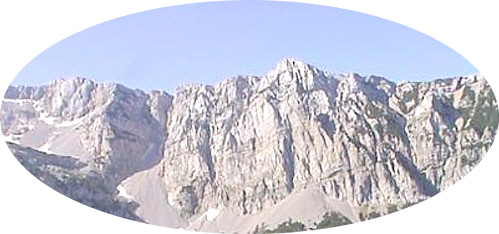
The barrier that had to be crossed was the formidable Dinaric Alps with clusters of peaks rising to over 8,000 feet Our Pilot was flying in a large circle in attempting to climb, and was very slowly gaining height. In consulting our Navigator on what options were available in this situation, he replied we had a choice of three. No.1, we could try to struggle back to base, No.2, we could follow the River to the Black Sea and Turkey, where of course we would be interned. Finally 3, if things got too bad we could bale out of the plane and hope to be picked up by Marshal Tito's partisans, and eventually returned to Italy.
Our rate of climb continued slowly, giving the Pilot sufficient confidence to suddenly shout "We're going Home!" and turned the aircraft towards the mountains. In front of us we could see two immense, snow-covered peaks, with a saddle between them. The Pilot had spotted this opening, and decided this was to be our gateway home. Judging distances when flying through a mountain range at speed and close to peaks is always an extremely difficult task. This was no exception, and as we approached, being unable to raise the aircraft any higher, it seemed to be an impossible task, and our thoughts turned to feeling we must surely crash into the mountain confronting us. Unfortunately, there is no room for error or second chances in this situation, and we did wonder if the 'saddle' or small space between peaks spotted from a distance, had given the Pilot false hope.
Suddenly, there it was, the saddle between the two peaks right in front of us. We scraped through with only a few feet to spare - it really appeared to be a very tight squeeze.
Crossing the Yugoslav coast, we still had the Adriatic Sea to cross. We were now slowly losing the height we had gained as the engine continued to lose power. It was therefore a great relief when we reached the Italian coast and eventually touched down on the runway at Tortorella. As the aircraft came to a halt, we all agreed that we had a lucky escape. It had indeed been "A Tight Squeeze."
Footnote: Bill Taylor did not reach the end of his flying experiences after the above episode, for following several more operations from Tortorella, his Wellington aircraft was badly damaged, and he was taken prisoner on Friday 13th July 1944. Bill describes this event in the story "Last Flight of 'S' for Sugar" which appears in the earlier Saltire Branch publication "Well - You Wanted to Fly" also published by Woodfield Publications - Editor.