
Library Reference Number: 203
My Final and Longest Op
Although I realised this final operational flight would take me 18 hours over the 500 hour limit for the ops tour, there was no way I was going to miss this final mission with the Doug Turner crew. I had flown with them for their last eight ops, since losing their original flight engineer when they ran out of fuel and ditched in the Indian Ocean. The drill on those occasions was to pump the sea water out of tired bodies and get back into the air. Having survived one ditching, Doug Turner had no intention of repeating the process, and we had established a good rapport in checking and rechecking my log containing every change of speed, altitude, fuel transfer and engine setting. Flight Log findings had led to the decision to ditch a few weeks earlier. Little did we know before setting off that our final operation together would be recorded at 23 hours 23 minutes duration – without ditching!
 At one time, there appeared to be a popular misconception that long flights were only carried out by aircraft undertaking patrols on search duties – not so! In spite of very long distances encountered while flying in the Far East we had specific targets in mind – as did the Japanese when their Invasion Fleet attacked Sri Lanka in April 1942. In return, the B24 Liberator offered the opportunity to take the offensive to Japanese-Occupied territory.
To achieve operations over very long distances, severe measures had to be taken. Our average fuel consumption was just under one mile per gallon, and it may be seen what our fuel load was if we intended to fly 3,500 miles. To keep our overall weight down we had to dismantle every piece of non-essential equipment including oxygen systems, and reduce ammunition to minimum. We also had to reduce number of crew members, dispensing with air gunners and take on multiple duties to compensate. For example I was not only flight engineer, but also pilot in emergency, air gunner approaching target, and dispatcher of agents and supplies over the target. The transfer of fuel from multiple extra auxiliary tanks at opportune times also kept me busy.
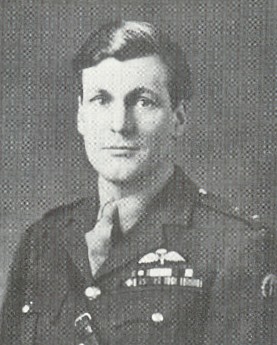
On 6th June 1945 we had a visit from Col. Chapman (post-war author “The Jungle is Neutral” - see picture on left) who had just escaped to Sri Lanka on board a submarine. He described events in Malaya where he had been working with guerilla forces harassing Japanese. He had organised our special duty dropping ops by short wave radios we had dropped earlier to those agents. Giving us good advice, but sadly unused by P/O Hynes who crashed into dense jungle on take-off the following day. F/O Sykes our Intelligence Officer who normally briefed us before an operation had volunteered to go on this flight to see things for himself, he was also killed with eighteen others.
 Briefed by replacement I.O. on afternoon of 27th July 1945, we made usual preparations checking survival kit. We carried .38 revolvers, commando dagger etc but had really only hope of joining a guerilla group if shot down Next morning on 28th July we had usual breakfast of bread filled with weevils, piles of dehydrated material pretending to be substitute bacon and egg and sweet potato. We then proceeded to dispersal for pre-flight check on Liberator BZ824 ‘W’ which in my case meant cutting locking wire on fuel caps to make visual check that all fuel tanks (main & auxiliary) were absolutely full to the top. Ground crews were absolutely first class, but one does not take another person’s word for it when it comes to checking fuel on long-range operations. Every part of the aircraft was then examined with each crew member checking appropriate items.
We took off at 11.01 local time, with all thirty tons of aircraft ‘W’ scraping through long grass at the end of the runway as usual. It was always a change of scene to leave the jungle setting of Minneriya Airfield. It sounds quite ludicrous now, but all we had to sustain ourselves for a 20+ hour mission, was one cardboard box containing weevil covered bread sandwiches and a few bottles of ‘jungle juice’ to drink. Anyhow, it’s said a person can become accustomed to their environment, and we had certainly become used to lack of adequate food. The first few hours of flight passed without incident, except a chance remark when we passed the area in the Indian Ocean where Doug and crew had ditched recently.
Reaching Sabang (later to become epicentre of the 2004 tsunami) we were already six hours ahead of Sri Lanka time. Sabang on north tip of Sumatra, had earlier been home to three squadrons of Japanese fighters. To make life easier for us, our Squadron Commander Squadron .Leader John Stacey had flown over in a Catalina and dropped a few bombs on their runway. Remarkably he survived the return to Sri Lanka, and soon afterwards led three of us over the Indian Ocean to pioneer and commence all those subsequent long-range missions.
Prior to reaching Sabang, I decided to transfer 660 gallons of fuel contained in the extra bomb bay tank into the main tanks; those being the only means of supplying the direct link to the four engines. My theory was that the bomb bay tanks were the most vulnerable to enemy fire from the ground – and we couldn’t afford to lose a drop.
 This particular transfer would have been frowned on by the Consolidated Aircraft Co. as it was crude by nature. I simply inserted one end of a hosepipe into the tank, fixed the other end to a fuel booster pump (not a standard fitting) then hastened up to the loft where the fuel transfer panel was situated. Adjusting the controls to direct fuel into main tanks supplying the engines, switched on the pump, then rushed down to the 9” wide catwalk in the bomb-bay to switch on the booster pump. I then calculated when the transfer was complete by hoping the pump was transferring fuel at the rate of 7 gallons per minute. Too long would pump air; too short a period would leave some fuel in supply tank. By comparison, the auxiliary wing tank transfer was much easier; the entire process being controlled from the fuel transfer panel in the loft. Fuel was transferred at times calculated to feed main tanks at earliest possible time in case of enemy action, also being careful not to start too early causing overflow.
We had now reached Penang and I felt like remarking to the skipper the well-known catchphrase “Do you come here often?” This was the scene of our first mine-dropping programme on 21st January 1945 where we dropped our first magnetic mines between Penang Island and the mainland; returning later to drop them right down Malacca Straits. This seemed quite effective as post-war statements reported ten Japanese supply ships had been sunk. (Local wooden vessels were undamaged). Penang had also between the refuelling point for the German submarine U862 which had subsequently led to our failure to detect it on its journey south to Australia.
 We also missed rushing up the mouth of the Perak River on this occasion. In the past, flying very low close to the river, we had attempted to fly under the Japanese radar beam. Being hopefully undetected, we had previously made our way well into the Malayan interior to find our dropping zones in the Cameron Mountains or other prearranged target areas well inside Japanese territory. But now, we continued our way close to the water of the Malacca Straits, the bright full moon casting our own shadow on the water as we moved south – this moving shadow giving a weird sensation over enemy territory.
Continuing south down the Straits of Malacca we encountered no enemy action as we skimmed the surface of the water. We felt much safer doing this than the risk of hitting the odd mountain further inland, and we were well practised in flying at low level over water. It seemed the Japanese were still convinced they were out of range of enemy aircraft, for on reaching Singapore every ship in the harbour was fully illuminated. It was quite a sight to see lights going out one by one in random order, as presumably by this time air raid sirens would be sounding at full blast. We didn’t wait to find out as we turned sharply east and made our way into the South China Sea.
While crossing Johore just north of Singapore, I could not help thinking of our POWs still suffering down there, and we couldn’t do a thing to help. Now it was time to focus even further on the task in hand. We made our run from the sea straight on to the DZ (dropping zone) and were inwardly congratulating ourselves on our good luck in not wasting time finding the target. We were further amazed at our good fortune to realise someone? had turned on the bomb-bay lights as we made the final run-in with bomb doors open, making ourselves the most well- illuminated target of all times for ground fire.
Thanks to Canadian Robert Quirk who tackled the massive task of reproducing ‘Operational Record Books’ of various Squadrons (rquirk.com), the following is the official record of our longest operation.
“5/10th Strato Cumulus on way out. Visibility 15 miles. At DZ, moonlight, slight high cloud. Made DR run from Kg Sedili Besar. All stores appeared to drop on DZ, and all chutes opened. DZ very good, flat and excellent reception. Pinpoint from coast brings aircraft onto DZ. At 1567Z kora Tinggi completely blacked out from 2000’ Nickels – e packs dropped between Benoy and Rengit. - Duration 23hrs 23mins” (‘Nickels’ = Leaflets).
We were personally delighted at the time that all had gone well with the drop, as those guys on the ground were really taking their lives in their own hands by being so close to Japanese strongholds near Singapore. By guerilla tactics they were harassing the enemy, but they still required the supplies we dropped to survive.
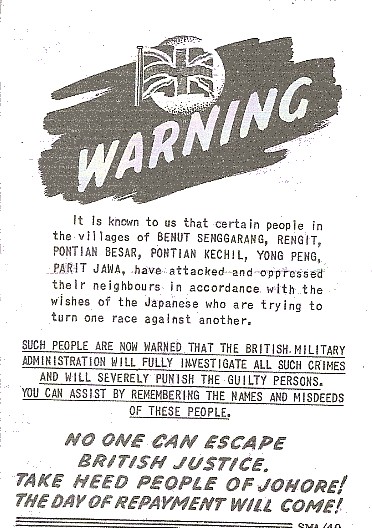 Having successfully dropped our main supplies, we now retraced our route back across Johore towards the west coast where we dropped information leaflets to the population around the Rengit area. It would have been tempting at this point to have shortened our long return journey back across the Indian Ocean by flying across Sumatra. We had no intention of doing so however, bearing in mind the number of previous attempts to do so had ended in disaster by crashing in mountainous areas. Our high altitude photo reconnaissance colleagues had made this a regular practice, but we had removed our oxygen systems (among lots of other things) to save weight for taking on extra fuel. It was therefore the long hard slog back by the long route, similar in length to re-crossing the Atlantic Ocean from UK. Our constant low level tactics had paid off. We had observed sporadic flashes and ground fire, but we did not encounter any serious attacks from enemy aircraft.
Back again up the Malacca Straits, past the once feared highly fortified Sabang equipped with fighter squadrons, we could begin to relax. It was now the testing time where we could forget the Japanese, but start to think about surviving the battle with the Indian Ocean in its great breadth and our diminishing fuel supply.
Leaving me to work out estimated duration with navigator Don Yeoman’s ETA (estimated time of arrival) most of the crew (including skipper) retired to the rear section for well-earned relaxation. Shortly after take-off, Don had squeezed past the retracted nose-wheel to take up his Navigator/bomb-aimer position in the nose. Just as well DVT was unheard of at that time, for remarkably, Don would spend over twenty hours in that extremely cramped situation; only reappearing on the flight deck shortly before landing, ready to report to 160 Squadron I.O.
For myself, swallowing some more issued caffeine tablets to keep awake, I recall sitting in the flight deck alone for several hours admiring the cloud formations we seemed to be floating on. After so long over enemy territory this appeared like heaven, until about the final five hours when other crew members perhaps recalling floating on the Indian Ocean instead, started to become anxious about our remaining fuel supply. I gained great pleasure in answering constant queries, that due to carefully flying on auto lean mixture at lowest possible RPM, we would soon be flying over the jungle tree tops of Ceylon. Our final longest op was over, and it was pure joy to see the seemingly solid mass of treetops before finding the clearing and runway which was our home at Minneriya. We hadn’t fully realised at the time any significant change to previous long flights, but discovered at debriefing that the duration of our final op was recorded at 23 hours 23 minutes by our 160 Squadron Ops Room staff.
Needless to say, the short-wave radios we had dropped on earlier operations had enabled the success or failure of our supply-dropping skills to be known many hours ahead of our return to base. This enabled our debriefing time to be much shorter. More than 24 hours after we had set off, we returned to another feast of dehydrated food of doubtful origin. This probably led to the Squadron Commander’s monthly report which stated “In view of recent attacks on the Japanese mainland most personnel are confident that the war in this theatre is progressing more quickly than was anticipated, and that the end is in sight. There is a belief that now VE Day is passed, there is still too little mention made at home of the war in this theatre. This is evident from both the BBC news and English newspapers. There is also general discontent with the quality of food being provided out here.”
Two weeks later our complaints about lack of food and primitive living conditions faded into obscurity when we witnessed the appalling condition of returning prisoners-of-war – the people we had flown over on our final op.
Dropping ‘the bomb’ had brought war in the Far East to such a sudden end, that the Japanese had no time to carry out their written instructions to slaughter all prisoners if the Allies came too close. The result was the evacuation of prisoners to Sri Lanka who were fit enough to survive the journey even if transported on stretchers. Unfortunately, I had to stand by and watch, as having completed 518 operational hours, I was grounded and not allowed to fly over to help. Some of the personnel meeting the returning prisoners were reduced to tears when they observed their emaciated condition. Yet we were advised we were only seeing the more able prisoners who had been adjudged able to be transported.
Colonel Chapman had spent four years in the Malayan jungle fighting with the guerilla forces, and when he came out by submarine a few weeks earlier, he had told us what to expect. Nothing could have prepared us for what we witnessed, and perhaps if those facts had been more widely recognised in the West, survivors would have been given more help on their return. They were in no condition to present a case for themselves.
Picture Footnotes:
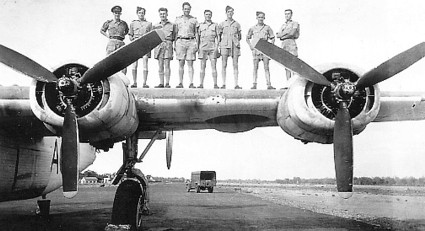
First Picture: Doug Turner Capt. 4th from left; Don Yeomans, Nav. 2nd from left. Jack Burgess, F/Eng. on extreme right.
Second Picture: Col. F. Spencer Chapman. Post war he wrote a book named “The Jungle is Neutral”. When he spoke to us at 160 Squadron, he was sporting a very large beard and was very dishevelled and suffering from tropical disease having spent four years in Malayan jungle. When being rescued he had to swim out to get aboard a submarine and then arrived at Trincomalee, Ceylon.
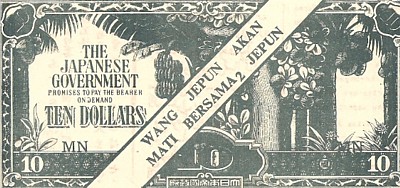
Third Picture: Propaganda currency notes that we dropped out by tens of thousands all over Malaya. The basic idea being to cause havoc to the Japanese when the people picking up the notes demanded cash value "as promised by the Japanese Government"
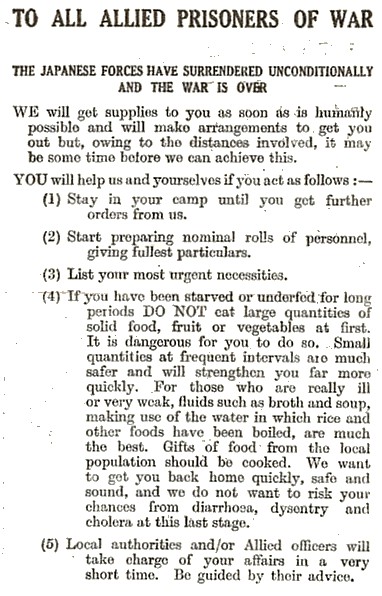
Fourth and Fifth Pictures: Examples of the leaflets being dropped into Malaya.