
Library Reference Number: 224
The Hartfield Thunderbolt
 During World War 2, thousands of new, multi-engined aircraft, built in USA and Canada, were flown to destinations in Britain, mostly via Prestwick, Ayrshire, and Burtonwood, Lancashire. Smaller aircraft had insufficient flying range, so these were delivered by sea.
Aircraft which were to be transported in the holds of ships were dismantled, then crated; later, they were reassembled in Britain. Aircraft carried as deck cargo remained almost complete, but were protected from the elements by plastic cocoons; these aircraft could be returned to flying condition with very little additional work. Deck-cargo aircraft landed at King George V Dock, Govan, Glasgow, were towed by road the short distance to Renfrew Aerodrome. To make this possible, many fine trees had to be removed from roadsides. The (US) Lockheed Corporation had a maintenance base at Renfrew where aircraft were returned to flying condition, then air tested, prior to delivery by air. Crated aircraft were reassembled at Renfrew or conveyed to Scone Aerodrome, near Perth.
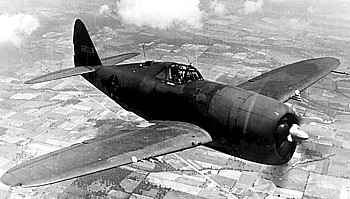
Two Republic Aviation designers, de Seversky and Kartveli, both Russian immigrants to USA, were responsible for the P- 43 Lancer which was built in small numbers. This aircraft looked fairly similar to the later P- 47 Thunderbolt which was the largest, heaviest and most expensive, single engined piston fighter aircraft of WW2. It was a juggernaut, a huge, powerful and overwhelming force, nicknamed" The Jug". The semi-elliptical wing platform had some aerodynamic advantage over more conventional forms but its main advantage was that the inner wing was broad and thick enough to accommodate undercarriage, guns and other bits and pieces. A considerable drawback was that the compound curves were difficult and expensive to build. Spitfires and a few other aircraft suffered from similar complications - but usually the results were pleasing to the eye.
The P- 47 had a Pratt and Whitney Double Wasp, 2-row, 18-cylinder, air-cooled, radial engine, having a capacity of 43 litres. (The Rolls-Royce Merlin, liquid-cooled engine had 27 litres; the Griffon had 37litres; modern family cars have engines mostly of 1.4 to 2 litres capacity). In the P 47, air entered through the "horse collar"- shaped, elliptical engine cowling, then was conveyed in a rectangular duct below the cockpit, to the supercharger. Most of the engine exhaust gases were conveyed rearwards in circular ducts on either side of the cockpit; these gases drove a turbine which drove the supercharger. After passing through an intercooler, supercharged (compressed) air was carried in two circular ducts forwards to the carburettor of the engine. Cooling of the supercharged air made it possible to supply the greatest possible weight of air to the carburettor, in order to derive the maximum power output from the engine. Almost unbelievably, air for com bustion was conveyed 22 feet before it entered the carburettor! Engine-exhaust gases and spent air from the intercooler were discharged from the underside of the rear fuselage. Perhaps surprisingly, this rather-complex system of aspiration worked well - both on paper and in practice! (Some liquid-cooled engines could be supercharged to higher pressures than air-cooled engines but the former were more susceptible to damage in combat.) The P- 47's 4-bladed propeller was around 13 feet in diameter.
This feature resulted in very little ground clearance, at take-off and landing. A long runway was necessary and considerable care was required to keep the tail fairly low during these phases of flight. Each undercarriage leg, when being lowered, was extended 9 inches by means of an electric motor. This was an expensive aircraft but it all worked - most of the time. The P-47 became a successful short-to-medium-range, high-altitude escort fighter but, somewhat surprisingly, also proved to be an effective, ground-attack machine. The sturdy airframe and robust engine made it fairly resistant to ground fire. The P-47D had a greater fuel capacity, and thus greater range, than earlier models; 12,602 were built, out of a total of 15,686.
Sadly, during WW2, flying accidents in Britain were numerous and widespread, causing casualties, often fatal, to many nationalities. The idea of commemorating this particular accident originated from Bill Kerr, from Paisley, who had been an RAF fireman, then spent a further 21 years as a fireman at Glasgow Airport. While flying r/c models near Hartfield Farm, he wondered why some trees were missing from either side of the access road, then started a lengthy investigation. Thank you for your efforts Bill! Just before he left the site on 29 November 2003, he was told by a man, whose father, a farmer, had been an eye-witness of an air-crash that the aircraft's propeller had landed in a nearby marsh. Probably it is still there!
On Wednesday, 29th December 1943, a P- 47D, Thunderbolt, took off from Renfrew on a delivery flight to Burtonwood. Minutes later, the aircraft crashed through trees bordering the access road to Hartfield Farm, killing the pilot, 2nd Lt Herman Carey, US Army Air Force. The crash site is south west of Caplaw Dam, just west of Gleniffer Road, the B775.
On Saturday, 29 November, 2003, a Memorial Service was conducted by Rev. Peter Houston, Glasgow Airport Chaplain, to commemorate the accident. (This event was held one month in advance of the 60th anniversary, to avoid anticipated travel problems close to the end of December.)
For several days, the weather had been fine - but not on Saturday! It was appalling, with gale-force wind and driving rain; the combination of gloom and noise from the trees was awesome. It could have been a scene from "Tam 0' Shanter", by Robert Burns. Despite these adverse conditions, the Aircrew Association, Air Training Corps, RAF Association and Royal British Legion Scotland all were represented. A US Air Force officer, on exchange posting to RAF Leuchars; Mr Douglas Alexander, the local MP; and Mr and Mrs Bill Kerr were also present. No 396 (Paisley) Squadron, ATC, provided two pipers who coped extremely well to make themselves heard above the din. The cause of the accident is believed to have been loss of the propeller - which would have had a profound effect on the balance and controllability of the aircraft. The Thunderbolt in the RAF Museum, Hendon, London, has a propeller of 13 feet diameter; a massive piece of machinery!