
Library Reference Number: 234
Earth Angels Rising
Looking back over the varied aircrew experiences in our ever-growing website library, we discovered a surprising number of aircraft had been involved with a North American origin. Those included the B24 Liberator; B25 Mitchell; B26 Marauder; DC3 Dakota; P47 Thunderbolt; PBY Catalina; and L5 Sentinel. Considering that such a variety of American aircraft types had been flown even within our own membership, this begs the question of not only how many of those aircraft reached so many world-wide war zones, but also how did this massive number of planes arrive there – and who delivered them?
This same question has also concerned Canadian author Ted Beaudoin over several years, for it was always assumed that military aircrew were fully occupied with flying operational missions without constantly returning to the aircraft companies to collect further supplies of new aircraft. Who then, accepted the onerous task of flying the large number of aircraft over the Atlantic to various war zones, especially when America could not be seen to be contravening neutrality laws during the early part of world war two, and Britain was under constant German bombing raids and the threat of Nazi invasion?
Some answers may be found shortly in a book “Earth Angels Rising” by author Ted Beaudoin which is now in its final preparation. Ted states “Why this title? To me these civilians were a lot like earth angels rising … rising to the rescue, when and where they were needed.” In the following account, Ted Beaudoin explains why he felt compelled to pay tribute to over 3,000 civilian men and women from more than 20 countries, who volunteered to take part in the largest special air delivery service we are ever likely to encounter. - Jack Burgess.
 This manuscript had its start in the mid-1980s, when I first became aware that something unique, and little known, had taken place nearly two full years before World War II had blown up into a world war. This something involved thousands of civilians who launched the world’s largest civilian-driven military airlift … an incredible logistics operation which the world had never seen before, and one which we should hope to never see again.
The background to this operation first caught my imagination in three chapters of my first book, “Walking on Air” - published in British Columbia, Canada, in 1986 as a soft-cover 300-page book about the life and spectacular accomplishments in aviation of the first Chief Pilot of Canadian Pacific Air Lines - Sheldon Luck.
That book contains three chapters dedicated to this operation, as Sheldon was one of the civilian aircrew members involved. In 2009 I took another look at this first book and re-issued it, adding 34 new pages and more previously un-published photographs, and had it published under a new title, “Pilot of Fortune.” I realized then how significant those three chapters were and that they could be expanded into a book of their own: only if I could find and speak with enough civilians - or members of their families - who were part of this daring operation between 1939 and 1945. A trickle of royalty payments from the second book since 2009, and search engine results revealed that both books are still listed as being for sale on a great number of web sites and that the potential for a third book existed.
What really bothered me was the fact that over the years, these same civilians have largely been overlooked and their stunning deeds were long forgotten, or trivialised or marginalised in many of the fine books on the operation. I had not really been fully aware of just how important these civilians were and how important was what they did until I began digging into the history of this operation. I began to realize that these civilians truly helped to make certain that I enjoy full freedom today as a Canadian citizen. Yet, I also discovered that few in Canada, the Commonwealth of Nations, or in the United States of America today seem to know or even care about them.
At first, this manuscript began as my own personal tribute to 3,500 unarmed men and women who came from 23 countries to put this happening into the history books. What exactly did they do to merit so much of my attention? They kick-started for Canada, for England and for the United States of America, a highly-secret and major undertaking which enormously helped all of the world`s allied armed forces prevent a global take-over by the German Nazi and Japanese war machines during WW II.
Their actions were considered foolish and potentially deadly. Their job: fly 10,000 unarmed twin-engine bombers, and later, single engine fighter aircraft, across uncharted and dangerous skies, by flying them first over the North Atlantic Ocean, and delivering them to UK overnight - ending the three months it used to take when these large bombers were being crated, shipped by boat and more often than not, sunk by Nazi U-boats who lurked below the Atlantic Ocean waters.
And why were civilians needed to do this obviously military job? There were simply not enough qualified and experienced aircrew and ground support crews among the entire British, Canadian or American armed forces to do the job, which needed to be done right away. Obviously qualified civilians, if they could be found, were the only way to get the job done. They were found. And how they were “found” is one of the key stories in my manuscript.
Also forgotten is the fact that about 500 of the 1,500 aircraft crews among those 3,500 civilians died in this heroic mission. This was a 30% death rate, almost equal to that of many soldiers, sailors and aircraft crews who died horrible deaths under enemy fire.
Now, thanks to more than 250 men and women on four continents who I have spoken with, and thanks to information I gained from the internet, I have collected many amazing and never-before-published anecdotes and stories about exactly what it was that these civilians did for us, how they did it, and what kind of dangers they faced daily to do this.
This manuscript has now become their tribute as well … it is no longer my tribute alone. I am grateful for such support.
No one should be blamed today for forgetting about these civilians since the war’s end in 1945. I am a strong believer in the old saying, paraphrased here: the “sins of the parents should never visit the children”. In the manuscript I have dedicated a section titled … No blame - no shame … which clearly explains what and why I mean when I write … no blame - no shame! … for our having forgotten about these civilians.
I can only hope that our governments of today - at least the Veterans’ Affairs departments in Canada, England and the United States of America - could find it in their hearts today to strike a joint Ferry Command Volunteer Medal for the so very few survivors - and for each of the families of all of the other civilians - and military personnel who later joined their ranks. These civilians gave us what became the Royal Air Force No. 45 Group - Ferry Command.
Such a medal is the very least that our allied nations could do … and it would cost so little.
Before my manuscript is published I will submit it to Canada’s Aviation Hall of Fame in Wetaskiwin, Alberta, Canada in support of my formal request. I will invite the Hall’s awards review board to grant each member of Ferry Command - civilian and military - its noted Belt of Orion award … to the few who are still with us and posthumously to all who have gone before - to honour them once and for all, albeit late, but with full dignity.
More information on this prestigious award is available on the CAHF web site … http://www.cahf.ca
Starting below, in indented italics, is a sample of the types of stories which are in the manuscript. This particular story is the core of Chapter 2 which describes what happened to a highly-publicized December 29th, 1940 flight from Gander, Newfoundland … a flight which could not have happened but which was reported in England as having taken place. A brief re-cap of how this highly-publicised flight came to be, and why this particular flight could not have happened, and why it was reported throughout England as having taken place .follows below . .
One of the more heart-warming and intriguing stories to come out of what became the Royal Air Force’s Ferry Command took place late in 1940, nearly one full year before the ravages of war spread beyond Europe and China and engulfed the entire planet.
This particular story involves the Lockheed and Vega companies. They were two giant American airplane manufacturing companies in California, USA. They and their 18,000 employees made and donated a twin-engine bomber - known as the “Spirit of Lockheed-Vega Employees”. It was meant to be a morale booster to the citizens of London, England, which was being pummelled daily by the Nazi Luftwaffe during the Blitz of London in the early winter of 1940. Local newspapers said the airplane had arrived safely on Dec. 30th, 1940.
It could not have arrived because it crashed on take-off the night before in Gander, Newfoundland. This is according to two witnesses I have had contact with.
This aircraft was part of the last batch of 28 identical aircraft to have been flown by civilian crews across the North Atlantic Ocean, starting with a series of four flights of seven aircraft each - the first one having arrived in Ireland on Remembrance Day, Nov. 11th, 1940.
These flights did the job they were intended to do: prove to naysayers and severe critics that such a fast delivery system of aircraft was indeed possible and practical … and that these badly-needed bombers, which England knew it needed, could now be delivered within hours, and not in weeks, to where they were needed, and when they were needed.
A sawed-off, bent and twisted propeller tip from the “Spirit” which was in my possession - thanks to one of my two witnesses - is clear evidence and testament that it could not have flown on to England and arrived there the next day. Despite this fact, there are four brief newspaper reports from England that record its arrival there the morning of the worst day of the London Blitz, making it a wonder that the mere arrival of any plane at all merited such limited news coverage.
The crashed aircraft, a twin-engine Lockheed Hudson bomber, registered T9465, had received much publicity - despite the alleged secrecy of the entire operation … with its delivery flight from California making headlines across North American newspapers, and featured in movie news film clips, magazines and radio news as the “Spirit of Lockheed-Vega Employees” made its way across the USA, Canada and on into Newfoundland.
With its new name emblazoned on both sides of the fuselage, in white capital letters fore and aft, it received vast media attention before it was built. When built, it was ready to be sent on its way to England with world-famous globe-trotting Jimmy Mattern in the pilot’s seat, who - in an incredible, but politically understandable and forgiven violation of the United States’ own revised Neutrality Act of 1939, in force at the time, flew it from Detroit, Michigan, right into St. Hubert airport, south of Montréal, Québec, on Christmas Day, Dec. 25th,1940, prior to its scheduled flight on into Gander, Newfoundland, four days later, where it was publicly claimed to have been flown overnight into the United Kingdom.
There is no doubt that an aircraft named “Spirit of Lockheed-Vega Employees” flew all right, but into history and not into the United Kingdom.
BUT … an aircraft bearing the name, “Spirit of Lockheed-Vega Employees” with the registry letters of T9465 did arrive in England … however, no one in Canada, nor could anyone in England, could confirm the exact arrival date of this obviously second, make-good aircraft bearing the same name. Yet the Imperial War Museum in London shows a plaque testifying to its arrival … and assignment in May, 1941, to the Royal Air Force 269 Squadron in Wick, Scotland. Wick is on the northernmost east coast of Scotland. From December to April represents a four-month information gap as to what actually happened to the original bomber, and when its replacement actually did arrive in London.
The heart-warming story of how this particular aircraft came to be, how it was flown across North America, and of how it’s obvious replacement by someone with a high authority and a very big heart -will unfold in Chapter 3 of the manuscript.
On Friday, May 11th, 2011, I presented the sawed-off propeller tip of the original Hudson, T9465, to the Dorval Museum, in Dorval, QC, on a temporary loan basis … until such time as I can make preparations to offer the original to the Imperial War Museum in England, and make 3-D computer generated copies to offer copies to any aviation museum in the world who would like to display this artefact from Ferry Command.
In the photograph taken at the Dorval Museum on Friday, May 11th, 2012, is my presentation of that sawed-off propeller tip from the “Spirit of Lockheed-Vega Employees” to Ms Beverly Rankin, Animator, Leisure and Culture, City of Dorval. Our group stands in front of a plaque commemorating Ferry Command, whose world-wide operations were headquartered at what was then known as Dorval Airport. With us, from left to right are Jean-Guy Pelletier, a Director of the Dorval Historical Society (DHS); Michel Hébert, President, DHS, Alain Jarry, a Director, DHS and Ken Watkins, member of the DHS and a WWII navigator. I have been told that the City of Dorval may issue some form of media release, or information brochure on this temporary loan to its museum, which is scheduled to open a special permanent section dedicated to the world’s first Ferry Command. (Photo by Sébastien Gauthier, photographer, City of Dorval)
What happened to the “Spirit” after it saw yeoman service out of Iceland, and was later transferred to the Sahara Desert? A desert prang ended its illustrious career.
To the best of my knowledge, there is not one single, solitary aviation museum in the world today that is dedicated solely to adequately and completely commemorating and showing how the civilians almost alone, and later, as a civilian and military mix, worked and worked so well - in other words, offering today’s generation, and coming generations, the whole front and back story of the RAF’s Ferry Command operation.
The only way I could comfortably - and accurately - tell the background story of what became Ferry Command was to write about some of the experiences of few of the civilian Ferry Command veterans - either as a result of personal interviews or through their families and / or other sources.
The paper trail of what became Ferry Command which to all intents and purposes was 100% funded by Britain’s Ministry of Air Production involved recruiting, interviewing, testing / evaluating and rating applicants for the job. Hiring them or returning to their homes those not accepted, along with purchases, civilian and military personnel payrolls, expense accounts, communications, security, anti-espionage efforts, catering, billeting and accommodations, equipment, services, accidents, safety records, flight-testing, training, traffic, military supplies, weapons, ammunition, complete weather records and runway conditions - the works. That trail is buried somewhere in piles of file boxes stashed in any number of places, making it just about impossible to follow.
Despite this serious difficulty, over the last few years I managed to scout around electronically and by snail mail and telephone into four continents - Europe, Africa, Australia and North America, along with Iceland, Greenland and Ascension Island in my attempts to find and speak with as many Ferry Command veterans as I could for this book.
The stories in the manuscript come from a combination of my own interviews along with, for example, some tape-recorded interviews on my behalf by a third party, such two interviews by Peter Dawson who interviewed for for me the late Gord Stemson, in Cowichan Bay, Vancouver Island, BC - and from memorabilia sheltered in various museums and libraries and personal family collections from Canada, England and the USA. Also several newspaper clippings, magazine articles, books and Pathé film clips of the era - corporate public relations offices of various companies and organizations - government and military archives in Canada and England - from children of some Ferry Command air and ground crews who have vivid and active memories of their parents’ work within Ferry Command. And last but not least, consent to reproduce much of the work of other historians who dealt in depth with material not fully covered by the range of books and other documents that deal with Ferry Command such as the dizzyingly-successful and dazzling Clayton-Knight Committee which legally lured more than 8,000 American civilian pilots into Canada when it was an obvious “no-no” to do that. Most of those recruited by the CKC went on to serve with either the RCAF and the RAF, and a handful with Ferry Command.
Below is a slowly-growing list - in no particular order - of those who have offered to help me, or have helped me, and are helping me flesh out this manuscript by adding some names, faces and some new stories to this manuscript:
Jack Burgess - United Kingdom … in his own words, Tuesday, May 14th, 2013:"My personal interest arises from the fact that although I crewed our own brand-new B24 Liberator across the Atlantic as an RAF member of 45(AT) Group, this was a very unusual occurrence. For the vast majority were flown over by civilians, and the B24 was so vitally important in winning the Battle of the Atlantic, as well as enabling us to embark on some of the longest operational missions undertaken in the Far East. I probably mentioned earlier, that I was so impressed by the extraordinary range of the B24 Liberator that I wrote several pieces in our aircrew association website - www.aircrew-saltire.org. Those appeared in the 'library section' of this website as Nos. 18, 56, 93, 120, 140, 163, 167, 180, 203. As already mentioned, the vast bulk of those large numbers of aircraft would probably be delivered to UK and the Far East by civilians, and hopefully, your publication should help in bringing those facts to light. I look forward to receiving more news when available."
Kim Champniss, Toronto, ON - (his Dad, Gerry Champniss was a Ferry Command pilot - now 93 years of age … he trained in St. Catharines, ON
Ivan Harman, Okanagan Valley, BC: an RFAC mechanic on duty in Gander, NL, the night of Dec. 29th, 1940 … he was my first witness to the crash of the “Spirit of Lockheed-Vega Employees.”
Peter Dawson, Cowichan Bay, BC, who interviewed Gord Stemson for me, and who is also the first man known to have set up the first full Ferry Command display at the Atlantic Air Museum in Gander, NL, Canada.>/p>
Sheldon Luck, first Chief Pilot, Canadian Pacific Air Lines and a civilian Ferry Command pilot, who became known as Prime Minister Winston Churchill’s personal mailman.
Bob and Jan Care, Oakville, ON, Canada.
Telf Denard, Toronto, Ontario, Canada, pilot.
Roderick Goff, Gander, Newfoundland and Labrador, Canada: a weatherman who was my second witness to the crash of the “Spirit of Lockheed-Vega Employees.”
Don McVicar, FC pilot, through his daughter Ms Donna McVicar Kazo, Florida, USA: he became a prolific writer and tried to found an international airline.
Kirk Kerkorian, Las Vegas, USA, civilian pilot, one of North America’s early billionaires.
Louis Lang, Montreal, Quebec, Canada, civilian radio operator.
Ed Lansdell, Penticton, British Columbia, Canada - pilot.
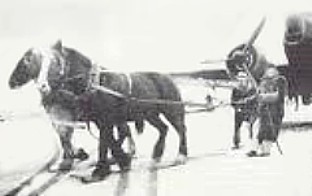
Elmer McClelland, Emerson, Manitoba, Canada - a witness to horses towing a bomber.
Time is now running out to find eye-witness accounts from surviving civilian pilots, crews or relatives of those who took part in the largest, world-wide civilian airlift of all time. Any further relevant information which has so far been undisclosed relating to those epic flying events would be greatly appreciated. Please sent any details to: -
Ted Beaudoin – e-mail: tedbeaudoin@yahoo.ca - Tel.: 905 - 714-1788 - Welland, ON, Canada.
Footnote: Final name in the above list (Elmer McClelland) refers to “horses towing a bomber.” This situation came about during the early part of world war two before USA entered the war. To get around the neutrality law, American aircraft manufacturers frequently arranged newly built planes to be towed over the Canadian border by horses or tractors. It could then be quite legitimately claimed that those American planes were not flown into Canada to help the Allied war effort. – Jack Burgess.