Library Reference Number: 240
Our Trip To Find Stag Luft VII & Stalag IIIa
 Being extremely difficult for members of a younger generation to fully understand what took place during world war two, family members of a Spitfire pilot shot down over Italy decided to visit former prisoner of war sites to find out for themselves what had taken place. The fighter pilot in this case being Warrant Officer Willie Comfort, No.111 Squadron, RAF, shot down while flying close to Rome on 4th June 1944.
A thousand thoughts must have passed through Willie Comfort’s mind during his crash-landing, for his elder brother had also been a pilot and had been reported missing during the Western Desert Campaign in 1942.
Aircrew Association member Willie Comfort described his capture in our website library account No.29, where he was later to find out that Allied prisoners of war were not detained in Italy, but were taken by the Germans into camps situated in Poland and Germany. This situation was bad enough, but worse was to follow because the Soviet army advancing westward towards Poland resulted in the Nazis making a decision to evacuate the PoW camps to prevent the liberation of Allied prisoners-of-war by the Russians.
In most camps such as Stalag Luft Vll where Willie Comfort was held, the POWs were broken up in groups of 250 to 300 men and because of the inadequate roads and the flow of battle, not all the prisoners followed the same route. The groups would march 20 to 40 kilometres a day - resting in factories, churches, barns and even in the open. Soon long columns of POWs were wandering over the northern part of Germany with little or nothing in the way of food, clothing, shelter or medical care. All this during the coldest winter months of the twentieth century, with blizzards and temperatures as low as –25 °C (–13 °F). Prisoners had been ill-prepared for this sudden evacuation, having only been given one hour to suddenly depart leaving most personal belongings behind. They had also suffered years of poor rations and only wore clothing ill-suited to the freezing conditions.
Different groups had different experiences, sometimes the Germans provided farm wagons for those unable to walk. With few horses available, sometimes teams of POWs pulled the wagons through the snow. Sometimes the guards and prisoners became dependent on each other, other times the guards became frustrated and hostile. Passing through some villages, the residents would throw bricks and stones, and in others, the residents would share their last food. Some groups of prisoners were even joined by German civilians who were also fleeing from the Russians. Some who tried to escape or became ill and unable to carry on were shot by guards.
The above paragraphs provide a brief background to what is generally known about the P.O.W. situation in which Willie Comfort found himself in January 1945. However, wishing to pay tribute to their father and observe the locations for themselves, family members arranged a visit to locations mentioned in their father’s wartime diary. After gathering all relevant information and thoroughly researching the subject, four members of the Comfort family set off on their mission.
* * * * *
On 3rd September 2013, which was exactly 74 years to the day since Neville Chamberlain announced to the nation that Britain was at war with Germany, my brother Ian, his wife Sue, my husband Willie and I embarked on a mission to Poland and Germany. The purpose of our visit was to locate the two P.O.W. camps, where our father Warrant Officer William S. Comfort, a Spitfire Pilot in 111 Squadron was incarcerated after being shot down and captured a few miles N.W. of Rome on 4th June 1944.
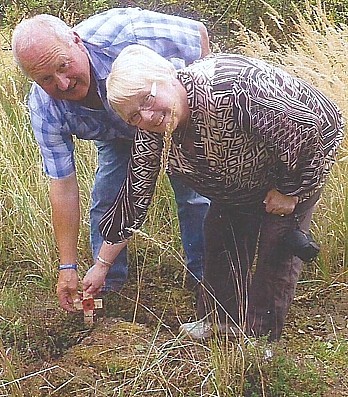 We arrived at Krakow Poland on 3rd September and on 4th September we travelled by private car hire to Bankau which was in Upper Silesia in 1944 but is now Bakow, a village near Kleuzbork, which is 135 miles N.W. of Krakow in Poland. After a two hour journey we arrived at Bakow. There is nothing to indicate where the site of the former Stalag Luft Vll is located but with the help of our own previous research and that of our driver we finally found the road leading into the camp.
It was a strange feeling walking on ground where our father had walked when he was a prisoner of the Germans all those decades ago. We explored the site which was extensive and found the foundations of numerous huts, guardroom, sick bay, ablution blocks, where the perimeter fence had been, the camp gate, and remains of concrete camp roads. Ian and I placed a Poppy Scotland cross with an inscription in memory of our father amid the ruins of a hut. I felt Dad’s presence with me as I walked along the road that he had been forced to march when the camp was evacuated at 3 a.m. on 19th January 1945 in blizzard conditions to an unknown fate.
After much searching and the help of a nearby innkeeper we were led on foot through a forest where we were shown the mass graves which our father had told us about. There was a stone inscribed in Polish which had been erected in 1978 in memory of all those who had lost their lives at Stalag Luft Vll. This was a very emotional experience.
Details of the March are recorded in Dad’s War Time Log for British Prisoners and in the book “The Last Escape” by John Nichol and Tony Rennel and the DVDs “The Long March to Freedom” which was televised on ‘Sky’ in November 2011.
We spent a further three days in Krakow visiting the Jewish Quarter, the Ghetto, site of Schindlers factory and Auschwitz all of which was a truly memorable experience. We then began the second leg of our journey and spent two nights at Wrocklaw which was formerly Breslau. From there we travelled through Poland and Germany to Berlin passing through some of the terrain which Dad had walked in 1945 from 19th January to 8th February a distance of 153 miles. They finally were entrained at Goldberg and after three days arrived at Stalag lllA Luckenwalde, 36 miles south of Berlin.
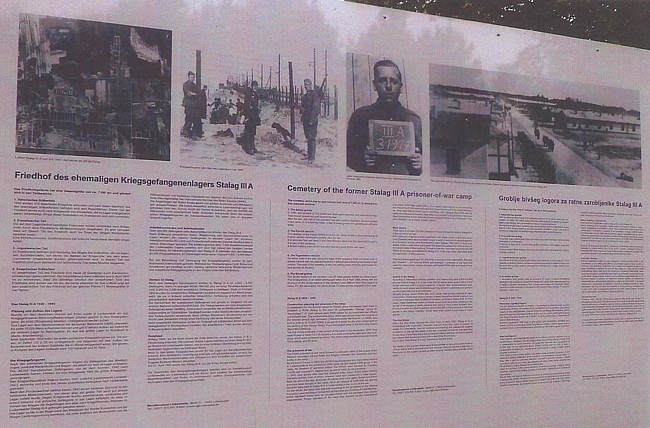
We travelled by train from Berlin to Luckenwalde and a taxi took us to the cemetery at Stalag lllA where we visited the mass graves and war memorials. There was an eerie feeling as we stood in the drizzling rain and one was aware that atrocities had been committed on the site nearby.
There is nothing left but remains of huts, shell holes etc. The entire complex was comprised of 100 buildings and infirmary plus tents during WW2. Towards the end of the war British and Polish prisoners as well as the first American and Romanian prisoners were shipped to the camp so that representatives from more than 10 different countries at war were interned there during the course of the war.
Ian and I placed another Poppy Scotland cross with an inscription beneath a Scots pine in the cemetery in memory of our Dad. We then visited Luckenwalde Museum and were given information by the helpful curator. The Museum houses a permanent exhibition about Stalag lllA. The exhibits gave us an insight into life in the camp which were very interesting.How our father and countless others survived that hell hole we will never know!
We left Luckenwalde in reflective mode.
We felt our journey to Poland and Germany to locate the sites of Stalag Luft Vll and Stalag lllA was a fitting tribute to our father who died in 19th January 2011. I will finish with a quotation from his wartime log book: - “The joy of escaping death can only be known by those who have experienced it, but it is mixed with the pain of the ordeal, which, one is hardly likely to forget.”